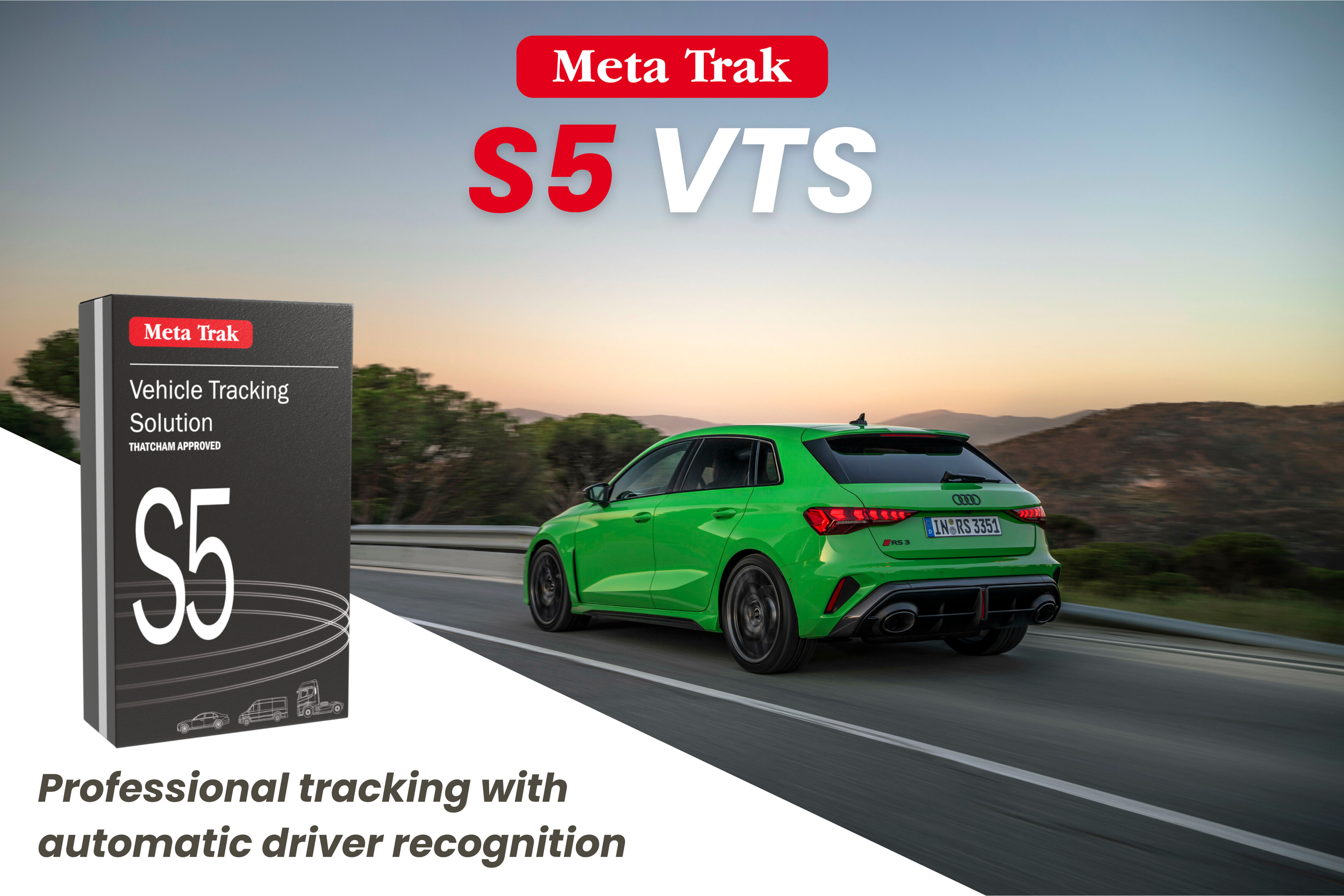
A GPS car tracker works out where your car is from satellite signals, then sends that position over the mobile phone network to an app or a monitoring centre, so the car can be found if it is stolen. A Thatcham S5 tracker adds driver ID tags and 24/7 monitoring, so a theft is picked up by the system itself rather than by you the next morning, and the monitoring team can help the police get the car back. The S5 trackers we fit start at £295 supply and installation for the Meta Trak S5 Tracker, with the ScorpionTrack S5 at £375, and both need a monitoring subscription.
A tracker finds a stolen car. It does not stop the car being stolen. For that reason the system we point most drivers to is the Meta Trak S5 DEADLOCK, priced from £469 supply and installation, which pairs the same S5 tracking with an aftermarket immobiliser that refuses the start attempt.
This guide takes car tracking one step at a time: how the tracker fixes its position, how that position reaches you, how it tells a theft from your own journey, what happens after an alert, and where a GPS vehicle tracker reaches its limits.
Car tracking in four steps
- Position. A satellite receiver inside the tracker works out where the car is.
- Reporting. A built in mobile connection sends that position on, to the app on your phone and, on a monitored system, to a monitoring centre.
- Detection. Sensors and, on an S5 tracker, a driver ID tag tell the system whether the car is being used normally or taken.
- Response. When something looks wrong, people act on it. The monitoring centre calls you and, if the car has been stolen, works with the police to recover it.
Every step has to work. A tracker that knows where the car is but cannot report it, or reports it to nobody, is of little use on the night the car goes.
Step 1: how a GPS tracker works out where your car is
GPS is one of several satellite navigation systems in orbit, alongside Europe's Galileo and Russia's GLONASS. Each satellite continuously broadcasts a signal carrying its own position and the exact time the signal left it. The receiver in the tracker sends nothing back to the satellites. It only listens.
Because those signals travel at a known speed, the receiver can work out how far away each satellite is from how long its signal took to arrive. With distances to at least three satellites, and in practice more, only one point on the ground fits all of them, and that point is your car. The method is called trilateration, and it is the same thing your phone does when you open a map.
Both S5 trackers we fit use multi frequency receivers that read GPS, GLONASS and Galileo together. More satellites in view means a quicker and steadier fix, which helps when a car is parked between tall buildings or under trees.
Where satellite positioning struggles
Satellite signals are weak by the time they reach the ground and do not pass well through concrete, soil or metal. In an underground car park, a steel shipping container or a closed garage, a receiver may not get a fix at all. The tracker still holds the last place it had a clear view of the sky, and some trackers can estimate a rough position from nearby mobile phone masts instead. The Meta Trak S5 Tracker is one of them, switching to cell based positioning when satellite signals are blocked.
That is why the speed of the alert matters so much. The sooner a theft is picked up, the more likely the tracker is still reporting a live position when the police start looking.
Step 2: how the location reaches your phone and the monitoring centre
Satellite positioning only tells the tracker where it is. To work as a GPS vehicle locator, the tracker also has to pass that position on, so it carries its own SIM and a mobile data connection, much like a basic phone with no screen.
The S5 trackers we fit use roaming SIMs that can connect to more than one mobile network, so a weak signal on one network does not leave the tracker silent. Positions and alerts go to the manufacturer's systems, which feed the app on your phone and, when something is wrong, the monitoring centre.
This is the main reason a monitored tracker needs a subscription. It pays for the mobile data the tracker uses and, on a Thatcham S5 system, for the people watching for alerts around the clock. Meta Trak systems include the first 1 or 3 year term at checkout, with renewals paid directly to Meta Trak. The ScorpionTrack S5 is sold as supply and installation only, and you arrange its subscription directly with ScorpionTrack after fitting. Our guide to what a car tracker costs sets out the first year and three year figures for each system.
Step 3: how a tracker tells a theft from your own journey
Knowing where the car is would not help much if the tracker could not tell whether you or a thief was driving. A Thatcham S5 tracker watches for several signs that something is wrong.
Driver ID tags
This is what sets an S5 tracker apart from a basic car GPS tracker. You carry a small ID tag on your keys. When the ignition is switched on, the tracker looks for the tag, and if the car starts moving without it, the system raises an alert on its own. Nobody has to notice that the car has gone. On the Meta Trak S5 Tracker the tags talk to the unit by Bluetooth Low Energy, two are supplied, and a tag battery typically lasts 12 to 18 months. The ScorpionTrack S5 comes with one tag and can also use your phone as a driver tag.
Movement with the ignition off
If the car's position changes while the ignition is off, for example because it is being towed or lifted onto a transporter, the tracker raises an unauthorised movement alert. A car taken without its engine running still triggers an alert.
Power being cut
A tracker is normally wired to the car's own battery. If that supply is cut, the tracker raises an alert, and Thatcham requires every S5 tracker to carry a backup power supply so it keeps working. On the Meta Trak S5 Tracker, the unit switches to its internal backup battery the moment power is lost.
Where it is fitted
An S5 tracker is hardwired by an installer and hidden inside the car, out of sight rather than in one standard spot that a thief could check on every car of the same model. Thatcham also tests S5 systems for resistance to attack.
Step 4: what happens when an alert goes off
On a Thatcham S5 tracker, alerts go to a monitoring centre staffed 24 hours a day, every day of the year. Someone calls you to check what is happening. If you are driving the car, or it is in for a service, that is the end of it. If the car has been stolen, the monitoring team works with the police, using the tracker's live position to guide them to it. Both S5 trackers we fit cover the UK and Europe, so tracking carries on if a stolen car is taken abroad.
That is what an S5 subscription buys over a self monitored tracker. With a basic tracker that only reports to an app, you are the alarm: you have to notice the car is missing, open the app and ring the police yourself, sometimes hours after it went.
Getting a stolen car back is never certain. Of the 53,629 private cars taken in the UK during 2025, only 44.94 percent were recovered, according to DVLA figures analysed by QuestGates. A tracker improves the odds for your car. It cannot promise the outcome.
Types of GPS vehicle tracker
Search for a car GPS tracker or a tracking device for your car and you will find very different products sold under the same name.
- Hardwired, professionally installed trackers. Wired into the car's electrics and hidden by the installer, with a backup battery. This is the type behind the Thatcham S5 trackers we fit.
- Battery powered trackers. Self contained units with no wiring, which wake up to report at set intervals so the battery lasts, and which can go on things with no power of their own, such as trailers and plant. Our wireless trackers cover this type.
- Plug in trackers. Units that plug into the car's diagnostic port. They are quick to fit, but the port sits in a known place, so they are easy to find and unplug.
- Bluetooth item finders. Small tags that rely on passing phones to report where they are, rather than satellite positioning and a SIM of their own. Handy for keys and bags, but nobody is monitoring them.
Where a policy names a Thatcham S5 tracker, the product has to be certified in that category. A self monitored tracker, whatever it is called, does not meet that condition. Our car trackers page lists every system we fit, from S5 trackers to wireless units.
What a Thatcham S5 tracker adds
Thatcham Research runs the certification scheme that UK insurers use for vehicle security. Its definition of a Category S5 vehicle tracking system includes:
- 24/7 monitoring by a centre meeting BS 8591 Category 1 or an equivalent standard
- A driver identification device
- GPS positioning and a roaming SIM
- Vehicle motion detection
- A backup power supply
- Resistance to attack for at least 2 minutes
Insurers ask for an S5 tracker mainly because of the value of the car. On higher value cars, having one fitted is often written into the policy as a condition of cover. Our guide what is a Thatcham device explains every category and how to read your insurer's wording, and you can compare every Thatcham S5 tracker we fit in one place.
What a GPS car tracker cannot do
Tracking on its own never prevents a theft. By the time an alert is raised, the car is already moving. It aids recovery, and it gives your insurer more confidence that the car will be found, which is why insurers ask for one, but the car still leaves your drive.
Stopping the car leaving is the job of an immobiliser. Any car registered new in the UK from October 1998 came out of the factory with one already fitted, rated Thatcham Category 2, and that factory fitted immobiliser takes its orders from the rest of the car's electronics. Relay attacks, key cloning and CAN injection each fool those electronics into treating a relayed signal, a copied key or injected messages as the genuine key, at which point the factory immobiliser stands aside. An aftermarket immobiliser sits outside the factory security that modern theft targets, so the start attempt is refused. Our article on how CAN injection gets past a factory immobiliser goes into the method in more depth.
Which car tracker we recommend
Every system below is Thatcham category S5 accredited and accepted by UK insurers that require a Thatcham S5 tracker.
Meta Trak S5 DEADLOCK
Our recommendation: tracking and an immobiliser
Supply and installation
From £469
What it does
Thatcham S5 tracking for recovery, plus an aftermarket immobiliser that blocks the start attempt without your ID tag.
Subscription
First term chosen at checkout, +£189.95 for 1 year or +£499.95 for 3 years. Renewals are paid to Meta Trak.
Warranty
Lifetime Meta Trak parts and labour warranty (original owner, active subscription)
Meta Trak S5 Tracker
Tracker only
Supply and installation
From £295
What it does
Thatcham S5 tracking for recovery, with two driver ID tags and 24/7 monitoring.
Subscription
First term chosen at checkout, +£189.95 for 1 year or +£499.95 for 3 years. Renewals are paid to Meta Trak.
Warranty
Lifetime Meta Trak parts and labour warranty (original owner, active subscription)
ScorpionTrack S5
Tracker only
Supply and installation
£375
What it does
Thatcham S5 tracking for recovery, with a driver tag or your phone as the tag, and 24/7 monitoring.
Subscription
Not included. You arrange it directly with ScorpionTrack after installation.
Warranty
2 year manufacturer warranty
Our recommendation, the Meta Trak S5 DEADLOCK. It is the same Meta Trak S5 tracking with an aftermarket immobiliser added. Every Meta Trak S5 DEADLOCK variant has an aftermarket immobiliser that does not take instructions from the factory CAN bus, so it blocks the start attempt however the car's electronics have been fooled, by relay, by key cloning or by CAN injection. If your ID tag is not in the car, the engine will not start. The system includes a Thatcham CAT2E accredited immobiliser, explained in our Category 2E guide. Our range of tracker and immobiliser systems shows the alternatives side by side.
A tracker on its own. Where the insurer wants tracking and you would rather not add an immobiliser, we offer two trackers as equal choices, the ScorpionTrack S5 and the Meta Trak S5 Tracker. Either one satisfies an insurer's request for a Thatcham S5 tracker, and the decision comes down to preference: the Meta Trak is supplied with two ID tags and its first monitoring term is paid at checkout, while the ScorpionTrack can use your phone as a driver tag and its monitoring plan is chosen with ScorpionTrack. For more on the second option, read our ScorpionTrack S5 buyer's guide.
An immobiliser on its own. Where no insurer has asked for tracking, the Meta AUTOBLOK is our standalone immobiliser recommendation, at £349 supply and installation and with no subscription at all. The Meta AUTOBLOK operates independently of the vehicle's factory electronics, so the engine will not start without its ID tag.
How buying works
Pick the system you want on its product page. On Meta Trak systems the first monitoring term, 1 or 3 years, is selected on the same page and paid with your order. The ScorpionTrack S5 price covers supply and installation alone, and its subscription is set up directly with ScorpionTrack after the fit. We then contact you to arrange fitting at your home, workplace, or even at the dealership before collection of the vehicle, and supply and installation is UK wide in an estimated 2 - 5 days. After fitting, the system is tested to confirm it is fully functioning. The certificate of installation is emailed by the product manufacturer after activation, and can sometimes also be found in the manufacturer's app.
Not sure whether you need a tracker, an immobiliser or both?
Answer a few quick questions and get a tailored recommendation for your vehicle, from a compliant S5 Tracker to a full tracker and immobiliser setup with OBD protection. It takes about two minutes.
Thatcham approved | Supply and installation UK wide | Insurance accepted
Frequently asked questions
How does a GPS car tracker work?
A receiver inside the tracker picks up signals from navigation satellites and works out the car's position from how long each signal took to arrive. The tracker then sends that position over the mobile network, using its own SIM, to an app and, on a monitored system, to a monitoring centre. A Thatcham S5 tracker also checks for your driver ID tag, so if the car moves without it an alert is raised and the monitoring team can work with the police to recover the car.
Does a GPS tracker work without a mobile signal?
It can still work out its position from the satellites, but it cannot pass that position on until it can connect to a mobile network again. The S5 trackers we fit use roaming SIMs that can connect to more than one network, which cuts down the places where a tracker is unable to report.
Does a car tracker work in an underground car park or a garage?
Satellite signals do not pass well through concrete, soil or metal, so in an underground car park, a shipping container or a closed garage a tracker may not get a satellite fix. It still holds the last position where it had a clear view of the sky, and the Meta Trak S5 Tracker can also estimate its position from nearby mobile phone masts when satellite signals are blocked.
Why does a GPS car tracker need a subscription?
The subscription pays for the mobile data the tracker uses to report its position and, on a Thatcham S5 system, for the monitoring centre that watches for alerts 24 hours a day. Meta Trak systems include the first 1 or 3 year term at checkout, with renewals paid directly to Meta Trak. The ScorpionTrack S5 is supply and installation only, and you arrange its subscription directly with ScorpionTrack after fitting.
Can thieves disable a car tracker?
A thief may try, which is why an S5 tracker is hidden by the installer, raises an alert if its power is cut and has a backup battery so it keeps reporting. Thatcham also tests S5 systems for resistance to attack. What no tracker can do is stop the car being driven away, so we recommend pairing tracking with an aftermarket immobiliser, which is what the Meta Trak S5 DEADLOCK does.
What is the difference between a GPS tracker and a Thatcham S5 tracker?
Any GPS tracker can show where a car is. A Thatcham S5 tracker is certified against Thatcham's criteria, which include a driver identification device, 24/7 monitoring, motion detection and a backup power supply, so a theft is picked up and acted on without you having to notice the car has gone. On higher value cars, insurers often make an S5 tracker a condition of cover.
Choose the right protection for your car
Get a recommendation for your car, see every tracker and immobiliser we fit, or call us to talk it through.
Sources
- QuestGates, QuestGates analysis of DVLA data reveals UK's most stolen car makes and models in 2025, 11 February 2026. DVLA data obtained under Freedom of Information.
- Thatcham Research, Vehicle Security Product Definitions Guidelines, Category S5 Vehicle Tracking Systems.
Pricing accurate at time of publishing.