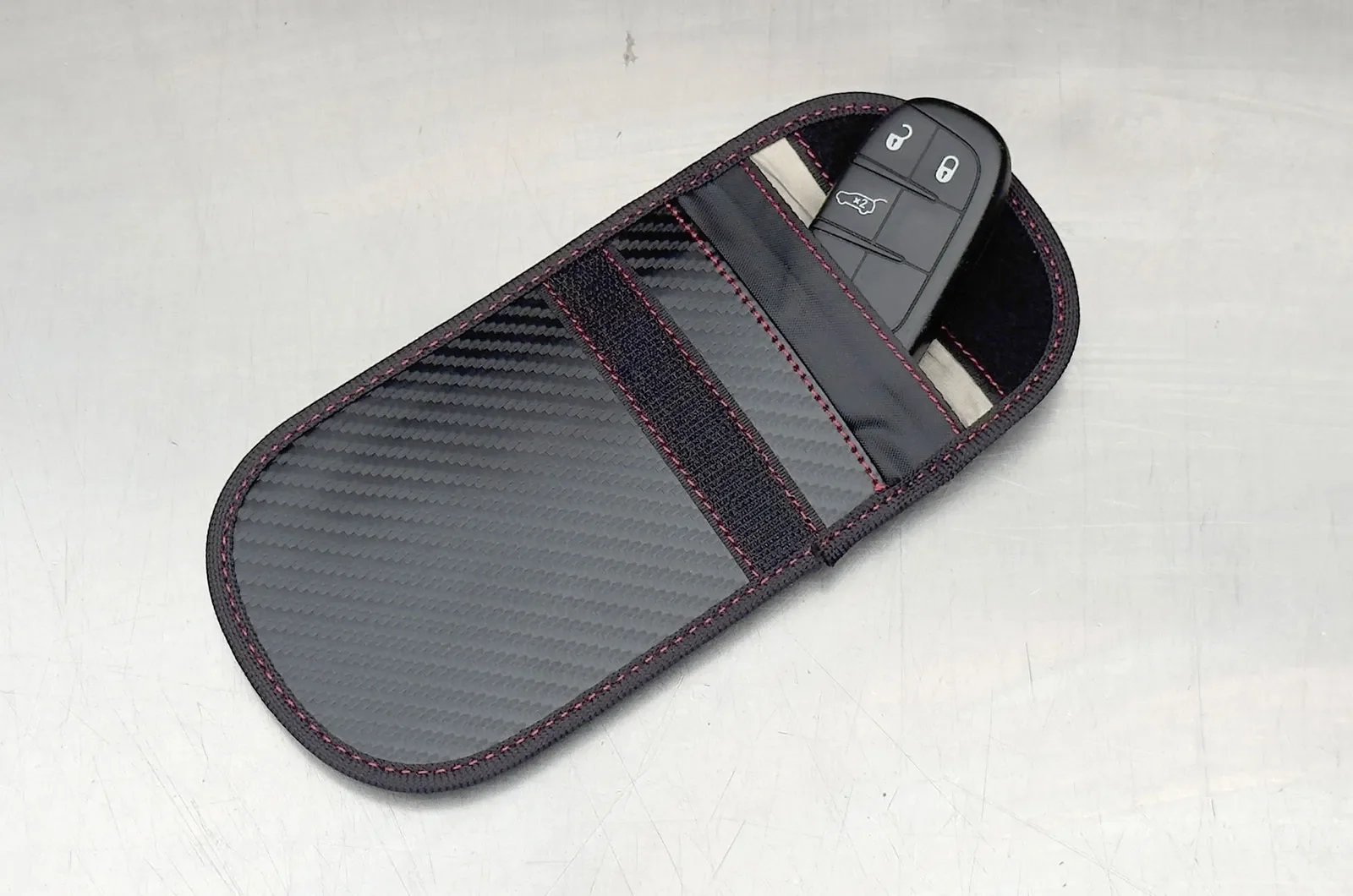
Yes, a Faraday pouch works against one theft method, the relay attack, as long as it is sealed properly, still in good condition and actually holding the key at the moment thieves arrive. It does nothing against CAN injection, which never uses your key at all, and that is why the protection we recommend for keyless cars is an aftermarket immobiliser: the Meta Trak S5 DEADLOCK, priced from £469 for supply and installation with tracking included, or the Meta AUTOBLOK at £349 if you want an immobiliser on its own with no subscription.
This guide covers what a pouch is actually blocking, what independent testing found, the ways pouches let owners down in everyday use, a two minute test you can do tonight, and why neither a pouch nor a key fob that sleeps can do anything about CAN injection.
What a Faraday pouch is actually blocking
A keyless car is constantly ready to talk to its key. When someone touches the door handle or presses the start button, the car sends out a short range signal asking whether its key is nearby, and the key answers. If the answer comes back correctly, the doors open and the engine will start.
In a relay attack, two thieves stretch that conversation. One stands near your house with a device that picks up the key's signal through the front door or a window, and passes it to a partner standing beside the car. The car believes its key is a metre away, so it unlocks and starts. Our article on keyless car theft and the new UK law goes into the methods in more detail.
A Faraday pouch is lined with a layer of conductive metallic fabric. Sealed around the key, that layer stops radio signals passing in or out, so the key never hears the car asking for it and has nothing to answer. If the key cannot be heard, there is nothing for the thieves to relay. That is the whole of what a pouch does, and against that one method it does it well.
Do they work? What independent testing found
Auto Express tested a range of car key signal blockers in a group test published in January 2026. Each pouch held a key while testers tried to open three keyless cars, and the pouches were then tumbled 1,200 times with keys inside, which the magazine described as simulating 18 months of being handled twice a day, before the cars were tried again.
When properly closed, every pouch in that test blocked the signal. The faults that did appear were about how a pouch is used rather than what it is made of. A pouch packed too full, or fastened carelessly, could let a faint signal escape, and one design with a magnetic catch rather than hook and loop fastening kept springing open. Those are exactly the kinds of slips that happen at home late in the evening.
Why pouches let owners down in real life
A pouch is a habit, not a system. It only protects the car when every one of these is true:
- The key is in it. Keys left on the kitchen side after the school run, or in a coat pocket by the door, are not protected.
- The spare is in one too. A second key sitting in a drawer near the front of the house is just as easy to reach.
- It is fully sealed. An overfilled pouch, a bunch of house keys stopping the flap closing, or a catch that has worked loose can all leave a gap.
- The lining is intact. The conductive layer is folded and rubbed every day. Once it cracks or wears through, the pouch can look perfect from the outside and stop working.
- Everyone in the house uses it. One family member who forgets is enough.
- You use it away from home. In a gym locker, a restaurant or an office, your key may be within reach of a stranger for hours.
None of this is a reason not to use one. It is a reason not to rely on one alone.
How to test your Faraday pouch in two minutes
You do not need any equipment. Do this with the car locked and in sight.
- Put the key in the pouch on its own and seal it exactly as you would at night.
- Hold the pouch right next to the driver's door handle and try to open the door.
- If the door stays locked, a quick second check: sit in the car with the doors unlocked by the normal method, seal the key in the pouch, and press the start button. A working pouch should leave the car reporting that no key is detected. Take the key straight back out afterwards and never leave a pouch with a key in it inside the car.
- Repeat with the spare key, and with every pouch or box in the house.
- Test again every month or so. If the door opens or the car starts at any point, replace the pouch.
Faraday box or pouch: which is better?
They use the same principle, so the better one is the one you will use every time. A box suits the house: it sits where keys are put down anyway, can hold both keys, and has no flap to fold wrongly. A pouch suits a coat or a bag when you are out. Whichever you choose, test it the same way, because a lid that does not close fully leaks just like a badly sealed pouch.
Other things to check on your own key
Some newer key fobs go to sleep when they are left still, so they stop answering the car until they are picked up again. Check your vehicle handbook to see whether your key does this, and whether keyless entry can be switched off in the settings menu. Both are worth knowing about, and both still only deal with the key signal.
The law has moved as well. The Crime and Policing Act 2026, which became law at the end of April 2026, made it an offence to make, possess, import, adapt or supply electronic devices used to steal vehicles, with a maximum penalty of five years in prison, an unlimited fine or a combination of the two. Reporting the change, Auto Express cited a Metropolitan Police estimate that electronic devices are used in around 60 percent of vehicle thefts in London. A possession offence gives police a better chance of catching thieves before a theft, but it does not change what happens on your driveway if they come anyway.
Why a pouch or a sleeping fob will not stop CAN injection
A Faraday pouch and a key fob that sleeps do the same job in different ways: each stops the key answering when thieves try to relay its signal. Against a relay attack, that can be enough. Against CAN injection it achieves nothing, because CAN injection does not use the key at all.
In a CAN injection theft, thieves reach the vehicle's CAN network, the internal network its control units use to talk to one another, from outside the vehicle. They then feed it the messages it would normally only act on once a genuine key had been recognised. The key can be sealed in a pouch at the far end of the house, or asleep on the hall table, and the outcome is the same. Our explanation of CAN bus injection walks through the method in more depth.
As installers, this is the shift we see. CAN injection has become popular because the routes relay attacks rely on are increasingly being closed off by sleeping keys, Faraday pouches and boxes, and because a relay attack needs more equipment and at least two thieves, whereas CAN injection can be done by one thief with a small CAN injector device. Thieves did not give up when the key became harder to reach. They moved to a method that leaves the key out of it. That is what we see on the vehicles we work on, not a published statistic.
So a pouch and a sleeping fob are worth having, but neither is enough on its own. Stopping CAN injection needs something the car's own network cannot talk round.
Other theft methods a pouch cannot stop
CAN injection is not the only method that never touches your key signal. These work just as well with the key sealed away:
- OBD port attacks. Thieves use the car's diagnostic port to reach the same network and take the vehicle by digital means, which can include programming a new key for themselves.
- Key cloning. Once a thief has a working copy of the key, for example one made through the car's own systems, the copy does the work of the original, so wherever you keep yours makes no difference.
- The real key. If keys are taken in a break in, no pouch makes any difference.
The reason all of these work is the same. Since October 1998, any new car sold in the UK has left the factory with an immobiliser built in, rated Thatcham Category 2, and that factory fitted immobiliser trusts the car's own electronics, so once they have been fooled it simply stands down. Our car immobiliser buyer's guide covers that weakness in full.
What actually stops the car being driven away
Every variant of the Meta Trak S5 DEADLOCK has an aftermarket immobiliser that does not take instructions from the factory CAN bus, which means the start attempt is refused whatever the car's own electronics have been told. Thieves can convince the car that its key is present by relay, by a cloned key or by CAN injection, and the engine still will not start, because the DEADLOCK immobiliser waits for its own authorisation rather than the car's. That is the gap a pouch or a sleeping fob leaves open, and it is why we treat both as sensible extras rather than the plan.
For most keyless cars our recommendation is the standard Meta Trak S5 DEADLOCK. It pairs Thatcham S5 tracking with that aftermarket immobiliser, and it immobilises automatically: without an authorised driver ID tag present, the engine does not start, so there is nothing to remember at night. The system includes a Thatcham CAT2E accredited immobiliser, explained in our Category 2E guide.
Be clear about what the tracking half is for. A tracker does not stop a theft. It gives the monitoring centre and the police the means to find the car after it has gone, which is why insurers on higher value cars often make a Thatcham S5 tracker a condition of cover. Having the immobiliser and the tracker in one system is what gives you both prevention and recovery. You can compare every tracker and immobiliser system we fit.
Our recommendations
Meta Trak S5 DEADLOCK
The one we recommend for most keyless cars
Supply and installation
From £469
What it does
Blocks the start attempt after a relay attack, key cloning, an OBD port attack or CAN injection, and adds Thatcham S5 tracking for recovery.
Subscription
First term chosen at checkout, £189.95 for 1 year or £499.95 for 3 years. Renewals are paid to Meta Trak.
Warranty
Lifetime Meta Trak parts and labour warranty (original owner, active subscription)
Meta AUTOBLOK
If you want an immobiliser on its own
Supply and installation
£349
What it does
The engine will not start without its ID tag. No tracking.
Subscription
None
Warranty
3 years
Meta AUTOBLOK. If you do not need a tracker for your insurer and simply want the car to stay put, the AUTOBLOK is the immobiliser we recommend on its own. The Meta AUTOBLOK operates independently of the vehicle's factory electronics, so the engine will not start without its ID tag. It arms itself, works with two supplied driver recognition tags set up for either proximity or a button press, and has no subscription at all. Browse our other engine immobilisers for comparison.
Electric and hybrid cars. If your car has any electrified powertrain (MHEV, PHEV or full EV) and its make is on Meta Trak's E-TEC compatibility list, currently selected Audi, BMW, MINI, Porsche, Bentley, Lamborghini and Rolls-Royce models, the Meta Trak S5 DEADLOCK E-TEC, priced from £599, is most likely compatible and is the system we recommend. It immobilises the start button itself, so the ignition cannot be switched on. The exception is a car that will go into drive with Ready on the dash without anyone pressing the start button; that one takes the standard DEADLOCK. The standard DEADLOCK suits every make, model and powertrain, so if you are unsure which applies, call us on 0330 133 3990.
For maximum protection. Securing the diagnostic port is part of keeping a keyless car safe, and many owners search for an OBD blocker or OBD port blocker to do it. What we actually install is an OBD port immobiliser: it is wired into the port's own circuit and lets access be granted or refused remotely, with no cage to fit and no key to carry. It comes with the Meta Trak S5 DEADLOCK PRO, priced from £599, for customers wanting maximum protection: on top of everything the DEADLOCK does, the OBD immobiliser prevents connection through the port itself, which shuts out injected software and data theft and stops new keys being programmed through it. You can see the wider range under OBD immobilisers.
How buying works
Select your system and complete checkout; for the DEADLOCK range you choose your first monitoring term there. We then contact you to arrange installation at your home, workplace, or even at the dealership before collection of the vehicle, UK wide in an estimated 2 - 5 days. Once the system is in, the engineer tests it to confirm it is fully functioning. For DEADLOCK systems, Meta Trak emails the certificate of installation your insurer needs after activation, and it can sometimes be found in the Meta Trak app as well.
Want to know what would protect your keyless car beyond a pouch?
Answer a few quick questions and get a tailored recommendation for your vehicle, from a compliant S5 Tracker to a full tracker and immobiliser setup with OBD protection. It takes about two minutes.
Thatcham approved | Supply and installation UK wide | Insurance accepted
Frequently asked questions
Do Faraday pouches work for car keys?
Yes, against relay attacks. A sealed pouch in good condition stops the key sending or receiving a signal, so thieves have nothing to pass on to the car. In a January 2026 Auto Express group test every pouch blocked the signal when it was closed properly, though some leaked a faint signal when overfilled or fastened carelessly. A pouch does nothing against CAN injection, OBD port attacks or key cloning, because those methods do not use your key signal.
How do I test a Faraday pouch?
Seal the key in the pouch on its own, hold it next to the driver's door of the locked car and try the handle. If the door opens, the pouch is not working. You can also sit in the unlocked car, seal the key in the pouch and press the start button to check the car reports no key, taking the key straight out afterwards. Test the spare key and every pouch or box you own, and repeat every month or so.
Do Faraday pouches wear out?
They can. The conductive lining is folded and rubbed every time the pouch is used, and once it cracks or wears through the pouch can look fine but let the signal out. Catches and flaps also loosen over time. Regular testing is the only way to know a pouch is still doing its job, and a failed test means it is time to replace it.
Is a Faraday box better than a Faraday pouch?
Neither is better in principle, because both block the signal in the same way. A box is easier to use consistently at home, where keys are put down by the door, and can hold both keys at once. A pouch is more practical when you are out. Whichever you use, test it, because a lid that does not close fully can leak just like a pouch.
Does a Faraday pouch or a sleeping key fob stop CAN injection?
No. Either one can stop a relay attack, because each stops the key answering the car. CAN injection does not use the key at all: thieves reach the car's CAN network from outside the vehicle, then tell it a genuine key is present, so a keyless car can be stolen with its key sealed in a pouch. As installers, we see CAN injection becoming popular because the routes relay attacks rely on are increasingly being closed off by sleeping keys, Faraday pouches and boxes, and because a relay attack needs more equipment and at least two thieves, whereas CAN injection can be done by one thief with a small CAN injector device. What blocks the start attempt is an aftermarket immobiliser that does not take instructions from the factory CAN bus.
What is the best protection against keyless car theft?
An aftermarket immobiliser that does not take instructions from the car's factory CAN bus. Every variant of the Meta Trak S5 DEADLOCK has one, so the start attempt is refused whatever the car's electronics have been told. Our pick for most cars is the standard Meta Trak S5 DEADLOCK, priced from £469 for supply and installation, which also adds Thatcham S5 tracking for recovery. If you want an immobiliser on its own with no subscription, the Meta AUTOBLOK is £349. A pouch is still worth using as an extra layer against relay attacks.
Make your keyless car hard to drive away
Find the right immobiliser for your car, see every system we fit, or talk it through with our team.
Sources
- Auto Express, Best Faraday bag car key signal blockers, group test, 29 January 2026.
- Auto Express, Keyless car theft devices outlawed at last, as police get new powers to track stolen vehicles, 29 April 2026.
Pricing accurate at time of publishing.