Why Your Toyota RAV4’s Factory Immobiliser Won’t Stop "CAN Bus Injection" (And What Will)

Updated April 2026
If you own a Toyota RAV4, the chances are you have already heard the phrase "CAN bus injection." You may have seen videos of vehicles disappearing in under 90 seconds. You may have read that your factory alarm and immobiliser are useless against it. All of that is true, and in this guide, we will explain exactly why, and more importantly, what security systems will actually prevent a theft from happening.
We install vehicle security systems across the UK, and we work with RAV4 owners every week. This guide reflects what we recommend in practice, not in theory.
What Is CAN Bus Injection and Why Are RAV4s Targeted?
The Toyota RAV4, along with the Lexus RX, NX and other models that share the same platform, is one of the most targeted vehicles on UK roads right now. This is not a coincidence. A specific vulnerability in the way these vehicles are wired has been discovered and is being systematically exploited by organised criminal gangs using sophisticated electronic equipment.
To understand the vulnerability, you need to understand how modern vehicles communicate internally.
Your RAV4 runs on a Controller Area Network, known as the CAN bus. This is effectively the nervous system of the vehicle. Every control unit on the car, including the engine management system, the gearbox, the body control module, and the door locks, communicates via this shared network. When you press the button on your key fob, a signal travels to the body control module via the CAN bus, which then unlocks the doors and disarms the immobiliser.
Thieves have learned to bypass the key entirely and inject commands directly onto that network.
How the Attack Works
On the Toyota RAV4, the wiring for the smart headlights connects directly to the CAN bus network. This wiring runs close to the front of the vehicle, near the bumper and wheel arch liner, making it accessible without entering the car. Thieves carry electronic devices, often disguised as Bluetooth speakers or battery packs, that can inject false commands directly onto the network from this point. It’s the easy access to the CAN bus wires that makes this theft method so fast and so devastating.
The attack sequence typically works as follows:
Peel. The thief peels back the plastic wheel arch liner, often in seconds, using basic tools.
Unplug. They locate the headlight connector and disconnect it, which is within arm’s reach of the wheel arch.
Inject. They plug their device directly into the now-removed headlight connector and flood the network with fake unlock and start commands.
Drive. The vehicle interprets these as coming from a valid key. The doors unlock, the alarm and immobiliser is bypassed, and the engine starts.
Total time from arriving at the vehicle to driving away: under 90 seconds. Your keys are inside the house. It made no difference.
It is important to understand that the headlight connector is simply the most accessible entry point on this model. CAN bus wiring runs throughout the entire vehicle. Thieves target the headlight because it provides access to the network from outside the car, without needing to get inside first. Other access points exist across the vehicle's wiring loom, and as security awareness grows, attack methods and vectors will adapt accordingly.
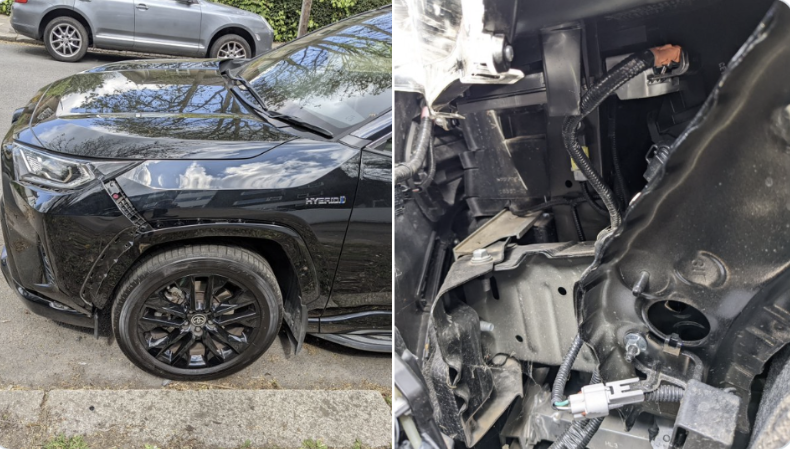
The peeled-back front bumper and wheel arch liner of a Toyota RAV4 reveal a method used by thieves to access the headlight and, subsequently, the headlight connector. This connector contains the specific CAN (Controller Area Network) line that thieves target to attach their CAN injection tool. Once they unplug the headlight connector, they connect their own CAN injection device, allowing them to inject fake unlock and start commands to steal the vehicle.
Why Your Factory Alarm and Immobiliser Cannot Stop It
Your factory immobiliser works by communicating with your key fob. If the correct encrypted signal is not detected, the vehicle should not start. The problem is that CAN injection bypasses this process entirely. Rather than trying to communicate with the key, thieves inject false confirmation signals directly onto the network, telling the vehicle's control units that key verification has already been completed. The factory immobiliser never gets a chance to respond.
Your alarm faces the same problem. It listens for door sensors, glass break sensors and tilt inputs. A CAN injection attack does not trigger any of these. There is no forced entry, no broken glass, no tilting. The alarm stays silent throughout.
What Actually Works: Your Options Explained Honestly
There are three systems we recommend to RAV4 owners, depending on budget and what matters most to you.
The Most Cost-Effective Way to Stop the Theft: A Stand-Alone Immobiliser
Meta AUTOBLOK
If your priority is preventing the vehicle from being stolen rather than recovering it after the fact, the Meta AUTOBLOK is the most cost-effective solution available.
The Meta AUTOBLOK is an aftermarket engine immobiliser that operates completely independently of your vehicle's factory systems and CAN network. It uses automatic driver recognition (ADR) in the form of an ID tag, a small keyring tag similar in size to an Apple AirTag. When the authorised driver and ID tag is present, the system disarms itself automatically. When they are not, the vehicle cannot be started, regardless of what commands are being injected onto the CAN bus. False signals on the network have no effect on it whatsoever.
It stops relay attacks, CAN bus injection from any point on the vehicle's wiring - not just the headlight connector, OBD port-based attacks, and key cloning too. It works because it sits entirely outside of the systems thieves have learned to manipulate.
The Meta AUTOBLOK does not include GPS tracking. If the vehicle were moved without being started, lifted onto a flatbed for example, there is no monitoring system to detect this or initiate a recovery response. For customers whose insurer requires a Thatcham-certified tracking system, or who want a more comprehensive security system, the next option is more appropriate.
Our Recommended System for Most RAV4 Owners: Combined Tracker & Immobiliser System
Meta Trak S5 DEADLOCK
For the majority of RAV4 owners we speak to, the Meta Trak S5 DEADLOCK is the system we fit. It combines automatic and remote engine immobilisation with Thatcham Category S5 GPS tracking and 24/7 professional theft monitoring in a single system and installation.
Automatic driver recognition. No pin entry, no button sequences, no driver input of any kind. The system arms and disarms automatically based on whether the authorised ID tag is in close proximity to the vehicle. If it is not there, the engine cannot be started.
Thatcham Category S5 certification. The highest category of vehicle tracking available in the UK. Required by most insurers covering high-risk vehicles. Your certificate is issued on the day of installation.
24/7 monitoring with motion detection. If thieves cannot start the engine and attempt to tow the vehicle instead, the Secure Operating Centre is alerted automatically via an unauthorised movement alert. They will contact you to confirm the situation. If a theft is in progress, professional recovery coordinated with the police is initiated immediately.
Over-the-air updates and remote diagnostics. The system can be updated and diagnosed remotely by Meta Trak, without requiring an engineer to visit.
This is the system we recommend because it addresses every element of the threat: it stops the theft, detects tow-away attempts, provides Thatcham S5 certification for insurance purposes, and includes professional recovery support if the worst happens. It’s also backed by a lifetime parts and labour warranty.
The Most Comprehensive Option: Multi-point Security System
Meta Trak S5 DEADLOCK PRO
The Meta Trak S5 DEADLOCK PRO includes everything above and adds a dedicated OBD port immobiliser
This means the OBD diagnostic port is physically secured at a hardware level, completely closing that access route to the CAN network. The engine immobiliser remains the primary defence in any CAN injection scenario. The DEADLOCK PRO ensures no access is possible via the OBD port under any circumstances, at both a hardware and software level simultaneously. It also prevents software from being injected onto the easiest of all access points, preventing malicious software from potentially causing permanent damage to ECUs, theft of personal and vehicle data, and stopping key cloning (new key programming) at the port.
For customers who want the most thorough installation currently available, this is the right choice.
We Also Install ScorpionTrack
As approved installers for both Meta Trak and ScorpionTrack, we carry the full ScorpionTrack range including Thatcham S5 and S5+ systems.
If you already have a ScorpionTrack system on another vehicle and want to manage everything from a single app, we can fit a ScorpionTrack system to your RAV4.
A Note on the Ghost Immobiliser
The Ghost is a well-known aftermarket immobiliser that does stop drive-away theft effectively. It operates by requiring the driver to enter a unique button sequence using the vehicle's existing controls every time the engine is started.
For some customers that works well and they are happy with it long term. For most of the RAV4 owners we speak to, the preference is for a fully automated system that requires no daily interaction at all. Entering a button sequence at every journey is something many customers find less practical over time, and for the typical RAV4 ownership demographic, a passive system that simply works in the background is generally a better fit.
The Ghost also does not include GPS tracking or professional monitoring. In a tow-away scenario, there is no alert system to detect the movement or initiate recovery; the Ghost is a stand-alone immobiliser.
Headlight Security Plates: Honest Advice
Toyota issued a technical bulletin (reference WB853) for RAV4 models covering a specific security plate (part reference GBNGABRACK01) that bolts to the back of the headlight assembly. The purpose is to make it more difficult for thieves to unplug the headlight connector cleanly, which, as covered above, is the most common access point for CAN injection on this model.
These plates can be fitted at Toyota dealerships and in some cases are offered as a goodwill gesture at no charge. It is worth calling your local dealer and asking directly.
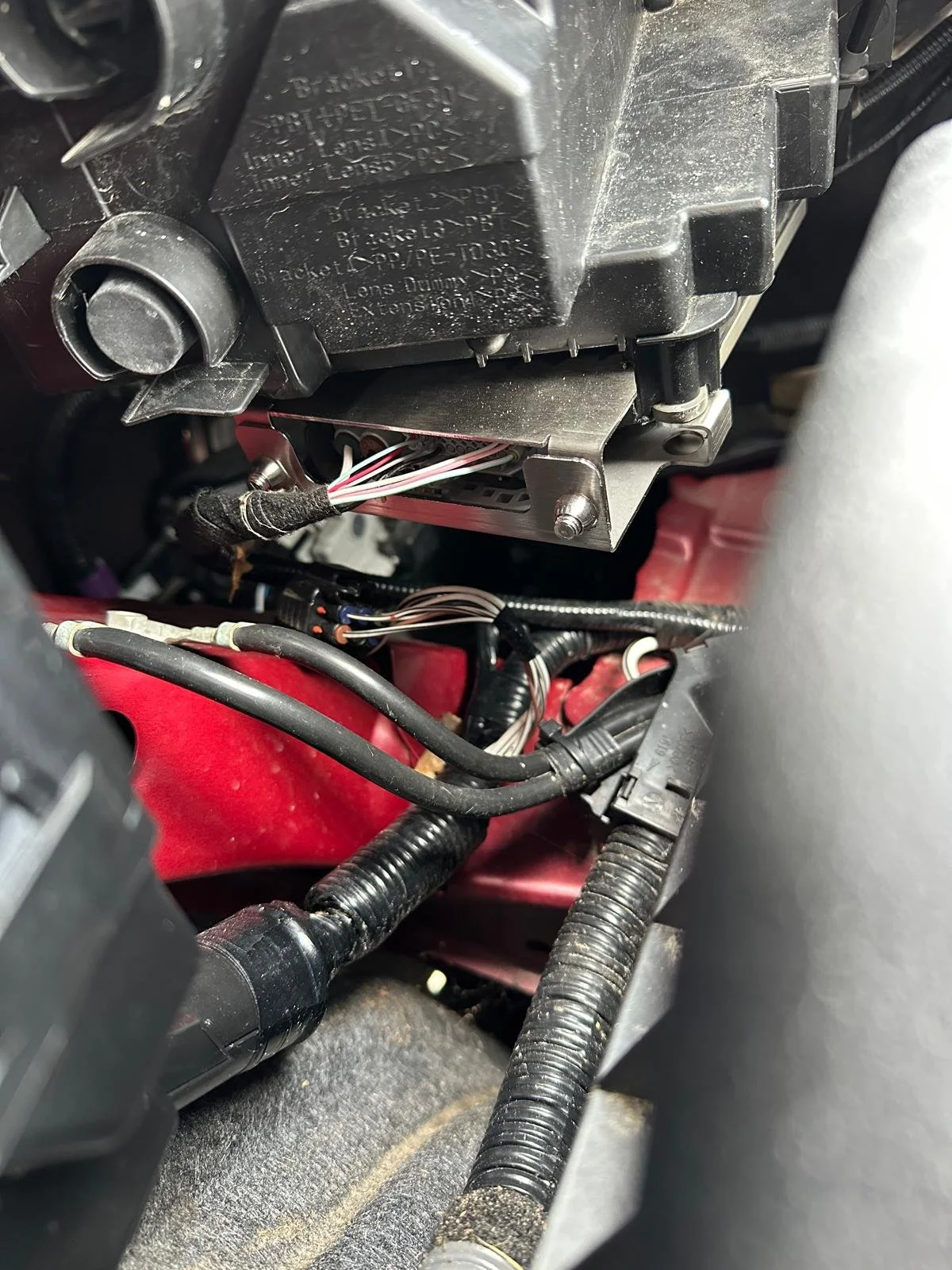
Toyota RAV4 Headlight Connector Security Cage
Here you can see the metal security cage fitted to one of our customers’ vehicles. The cage is bolted in from the front side, making it difficult to remove, especially through access from the wheel arch. The cages prevent thieves from simply disconnecting the connector to plug in their own hardware. The plastic you see above this cage is the headlight housing, where we’re looking at the back of the headlight here.
Additionally, notice how close the headlight connector is to the wheel arch, just beneath the felt-like material. From this position, it's easy to imagine how thieves could pull down this liner and reach up to disconnect the headlight connector, all within arm's reach.
What these plates do: they increase the time and difficulty involved in performing a CAN injection attack via the headlight connector. They may deter a thief who is working quickly and does not want complications.
What they do not do: they do not prevent CAN injection, and they do not secure the vehicle against theft. CAN bus wiring runs throughout the vehicle. A determined thief can still access the CAN wiring at the headlight connector loom by joining directly to the wires, bypassing the connector entirely. This takes longer and is less clean, but it is possible. Over time, as more RAV4s have these plates fitted, attack methods will likely adapt to other access points on the vehicle.
Our honest view: if you can get the plate fitted at your dealer quickly and at no cost, it is worth doing as a deterrent. It is not a substitute for a professionally installed immobiliser and tracking system.
Our Recommendation for Toyota RAV4 Owners

Meta AUTOBLOK
If budget is the primary consideration and stopping the theft is the goal: A stand-alone ADR immobiliser such as the Meta AUTOBLOK will suffice.
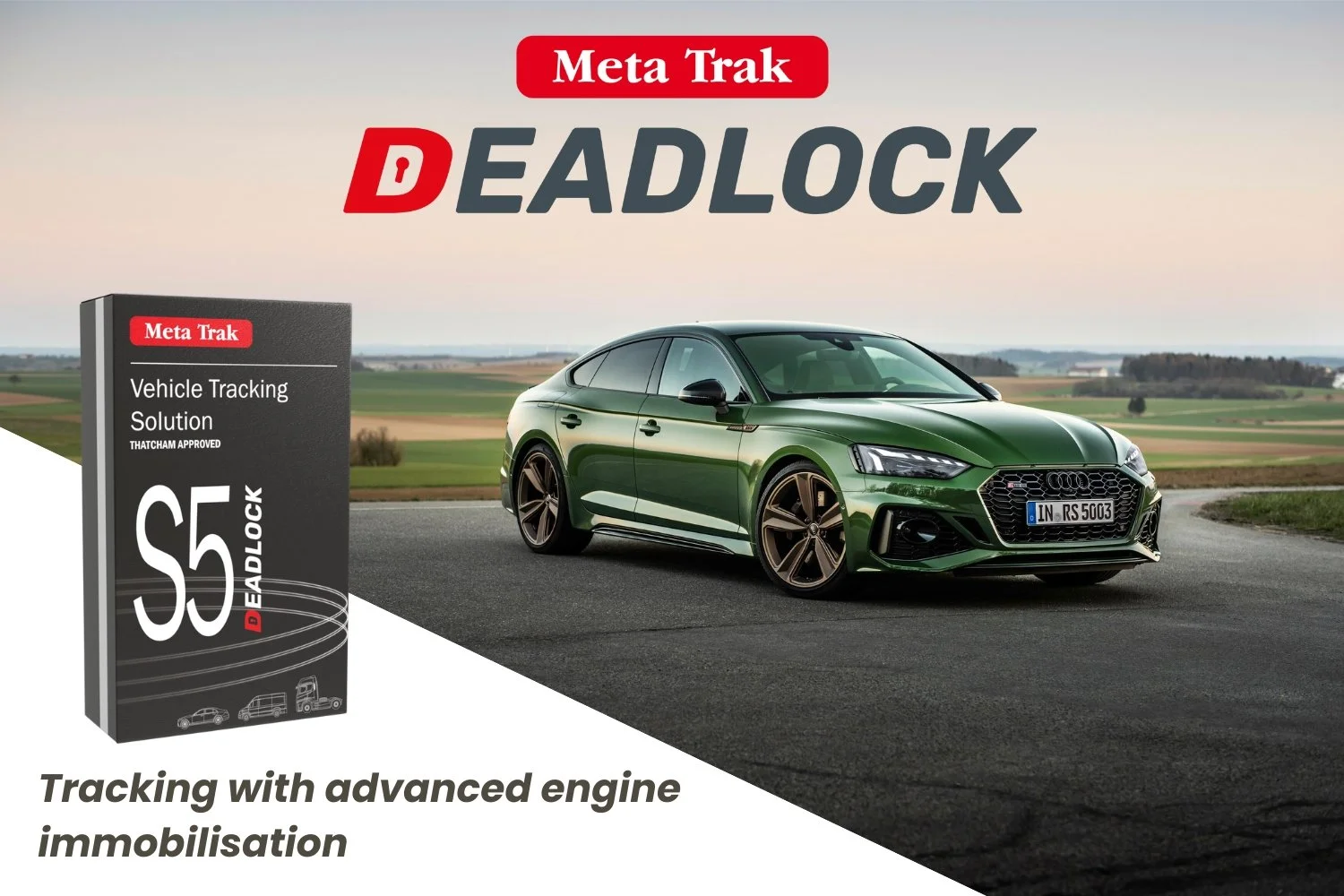
Meta Trak S5 DEADLOCK
If you want Thatcham certification for your insurer, full tracking, and professional monitoring alongside theft prevention: Meta Trak S5 DEADLOCK. This is the system we fit to most RAV4s we see.
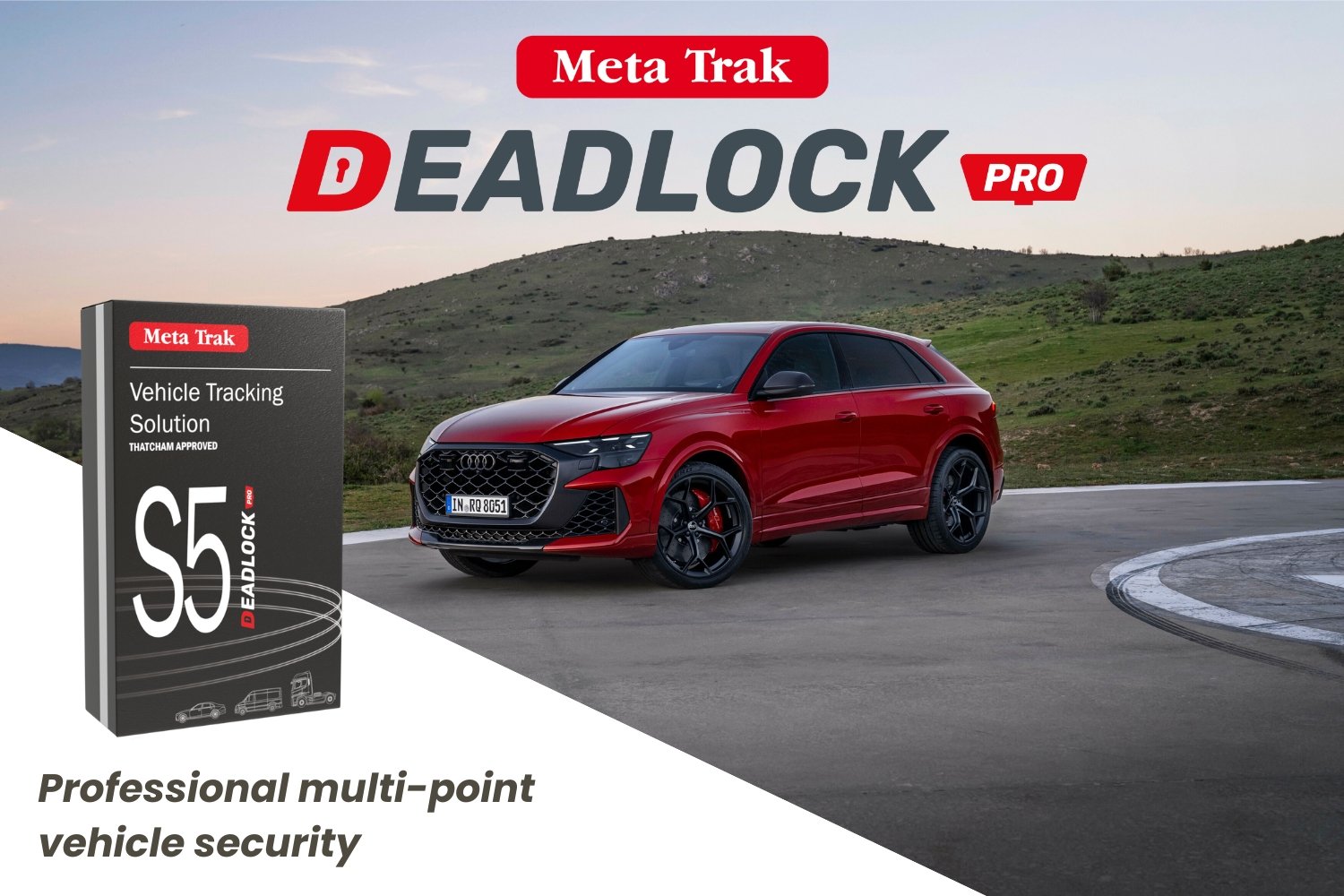
Meta Trak S5 DEADLOCK PRO
If you want the most complete installation available: A multi-point security system such as the Meta Trak S5 DEADLOCK PRO
All three are supply and installation packages. We come to you, anywhere in the UK, and complete the installation at your home or workplace within 2 to 5 working days. Your proof of installation certificate is issued on the day.
suits your RAV4?