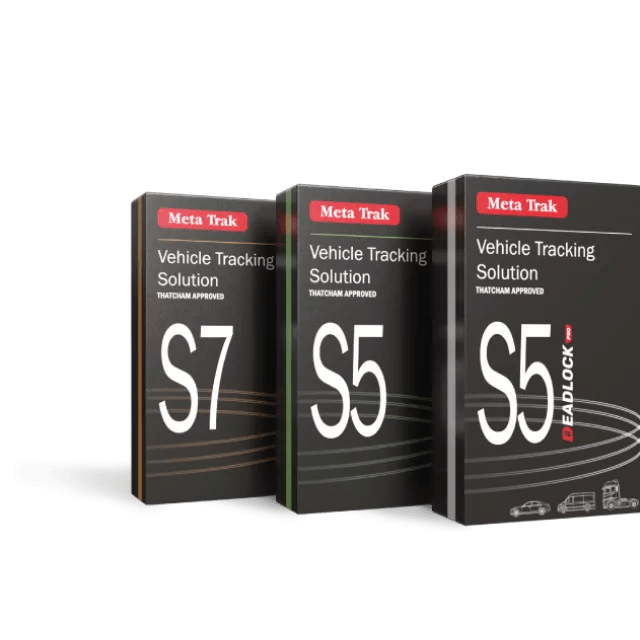
An insurance approved tracker is a Thatcham certified tracking system in the category your insurer has named, usually Thatcham S5 or Thatcham S7. Before you buy, find the exact wording in your policy schedule, match it to a category, and check what the insurer expects once the system is in, because a tracker condition can cover the subscription as well as the unit itself. Prices for supply and installation begin at £185 for a Thatcham S7 tracker, £295 for a Thatcham S5 tracker and £469 for the Meta Trak S5 DEADLOCK, the tracker and immobiliser we recommend.
This guide is for drivers who have been given a tracker condition on a new policy or at renewal and want to be certain that what they fit will be accepted. It covers where the requirement is written, how to read it, the questions worth putting to your insurer or broker, and what keeps the condition met after fitting. If you would like the background on every Thatcham category first, our guide to what a Thatcham device is covers it in full.
What an insurance approved tracker means on a policy
Insurers do not test tracking systems themselves. They rely on Thatcham, which runs the certification scheme for vehicle security products, and they write the Thatcham category they want into the policy. So when a policy or a broker asks for an insurance approved tracker, it nearly always means a system certified by Thatcham in a named category. A few insurers word the condition around their own approval instead, asking for a tracking device approved by that insurer. If your wording does not name a Thatcham category, ask which systems they accept before you order.
Vehicle value is the main reason an insurer asks for a Thatcham S5 tracker. The more an insurer would have to pay for a car that is never recovered, the more likely it is to make a tracker a condition of cover. You can see every system that meets these categories on our insurance approved vehicle trackers page.
Where to find your insurer's tracker requirement
A tracker requirement is a written condition, so it will be somewhere you can read it again. Look in these places:
- The policy schedule. Tracker conditions normally appear here as an endorsement, often a short code followed by a sentence of wording.
- Your renewal notice or quote documents. A condition added at renewal is often pointed out in the covering letter or email.
- The policy booklet. This explains what the endorsement means in practice, including what happens to theft cover if the condition is not met.
- Your broker. If you bought through a broker, they can ask the insurer for the exact wording and for the systems it will accept.
Keep that wording to hand. It is the most useful thing you can share with us when you order, because it shows exactly which category and features your insurer expects.
Reading the wording: which insurance approved tracker it points to
Insurers do not all use the same words for the same requirement. These are the phrases we see most often, and what each one is asking for.
"Thatcham Category S5", "Thatcham S5 tracker" or "S5 tracker with ADR"
A Thatcham S5 tracker. Every Thatcham S5 tracker includes Automatic Driver Recognition (ADR), which many insurers ask for by name. ADR works differently depending on the brand, for example keyring driver ID tags or phone app based recognition.
"Vehicle tracking system" or "VTS"
Some insurers write a Thatcham S5 requirement this way. Read it as a request for a Thatcham S5 tracker unless the same sentence names another category.
"Thatcham Category S7"
A Thatcham S7 tracker. Thatcham S7 tracking systems feature 24/7 monitoring and professional theft support. A Thatcham S5 tracker also satisfies this wording, as the FAQ below explains.
"Tracker and immobiliser" or "S5 tracker and immobiliser"
A Thatcham S5 tracker combined with an immobiliser, which our tracker and immobiliser range covers. A Meta Trak S5 DEADLOCK system or the ScorpionTrack S5+ meets a request for a Thatcham S5 tracker and immobiliser.
"Category 5", "Category 6" or "Category 7"
Policies written some years ago may still use these older numbers. Your insurer can confirm what it expects today, and the Thatcham device guide linked above explains the history.
"Approved tracking device", with no category given
The insurer has not said which standard it wants. Ask your insurer or broker, in writing, which category or which systems they accept, and keep their reply.
Five questions to ask your insurer before you buy
A short email to your insurer or broker before you order can save a second visit later. These five questions cover what matters:
- Which Thatcham category do you require? If the answer is S7, an S5 tracker satisfies it too.
- Do you require an immobiliser as well as a tracker? Some policies now ask for both, and the answer changes which system you need.
- By what date must it be fitted? Some conditions apply from the first day of cover. Give us the date when you order so the visit can be booked around it.
- What proof do you want, and where should I send it? Most insurers ask for the certificate of installation.
- What does the policy need from me after fitting? Check whether the system must stay in operation with an active subscription, and whether you must tell the insurer if you change the system.
Keeping an insurance approved car tracker condition met
Fitting the system is the first half of the condition. The second half is keeping it working. Every tracking system we fit, whichever the brand, needs an active subscription to track, and on the Meta Trak S5 DEADLOCK the immobiliser needs one too.
Published decisions from the Financial Ombudsman Service show why this matters. In one (reference DRN-4036177), the policy schedule read: "A tracking device must be fitted to this car and have a current network subscription for Theft cover to apply." The car had a tracking device fitted but no active subscription, the insurer declined the theft claim, and the ombudsman did not uphold the owner's complaint. In another (reference DRN-3462814), the schedule required an approved tracking device to be "fitted and in operation" with the subscription to the system operator maintained, and a complaint about a declined theft claim was again not upheld.
How the subscription is paid depends on the brand. On Meta Trak tracking systems, the first 1 or 3 year term is chosen on the product page and paid with your order, and later renewals are paid directly to Meta Trak. A ScorpionTrack price covers supply and installation only, and you set up and pay the ScorpionTrack subscription yourself, directly with ScorpionTrack, once the tracker is fitted. Whichever you choose, note the subscription renewal date beside your policy renewal date so the two never drift apart.
What will not meet a request for a Thatcham tracker
- Self monitored trackers. The Meta Trak Shield and Shield PRO are self monitored: there is no professional monitoring and no theft support. The Meta Trak Pulsar is self monitored too. None of the three is Thatcham certified, so none satisfies a policy that names a Thatcham category. They suit owners who want to see where a vehicle is without an insurer condition to meet.
- Consumer GPS units and Bluetooth tags. Plug-in GPS trackers and Bluetooth item finders bought online are not Thatcham certified tracking systems, so they do not count towards the condition.
- A system without an active subscription. As the ombudsman decisions above show, a device that is fitted but not in operation may not satisfy the condition.
- A manufacturer fitted tracker you have not checked. If your car left the factory with a tracking system, ask your insurer whether it meets the condition, and make sure its subscription has been activated.
Proof for your insurer
The document insurers usually ask to see is the certificate of installation. The manufacturer emails it once the system has been activated: Meta Trak's certificate is issued on the day of installation, and ScorpionTrack's once your ScorpionTrack subscription is active. Send it to your insurer or broker by the date they gave you, and keep a copy with your policy documents. Our guide to the fitting visit walks through the day itself.
The condition protects the insurer. An immobiliser protects the car
Recovery is what a tracker offers: it helps find the vehicle once it has gone, but it does nothing to keep it on the drive. That is why insurers value it, and why we recommend pairing it with an immobiliser even when the policy only asks for a tracker. Modern theft targets the factory fitted immobiliser that every UK car has carried since October 1998: relay attacks, key cloning and CAN injection all persuade the vehicle's own electronics to let the engine start. Our article on why a factory immobiliser will not stop CAN bus injection explains the method in full. The immobiliser in every DEADLOCK variant sits outside that conversation. Because it takes no instructions from the factory CAN bus, it refuses the start attempt regardless of what the car's own systems have been persuaded to accept, whichever route the thief used.
Insurance approved trackers we supply and install
Each system below is fitted by a brand-approved engineer and meets the Thatcham request shown on its card.
Meta Trak S5 DEADLOCK
Recommended. Meets a Thatcham S5 tracker and immobiliser request
Supply and installation
From £469
In the system
An S5 tracker with ADR through Meta Trak ID tags and 24/7 monitoring, joined by an aftermarket engine immobiliser that blocks the start when no tag is present.
Subscription
First term chosen at checkout: 1 year (+£189.95) or 3 years (+£499.95). Renewals paid directly to Meta Trak.
Warranty
Lifetime Meta Trak parts and labour warranty (original owner, active subscription)
Meta Trak S5 Tracker
Meets a Thatcham S5 tracker request
Supply and installation
From £295
In the system
An S5 tracker with ADR through Meta Trak driver ID tags, monitored 24/7. Helps recovery after a theft but has no immobiliser to stop the engine starting.
Subscription
First term chosen at checkout: 1 year (+£189.95) or 3 years (+£499.95). Renewals paid directly to Meta Trak.
Warranty
Lifetime Meta Trak parts and labour warranty (original owner, active subscription)
ScorpionTrack S5
Meets a Thatcham S5 tracker request
Supply and installation
£375
In the system
An S5 tracker with ADR through a ScorpionTrack ADR tag or the ScorpionTrack app on your phone. Helps recovery after a theft but has no immobiliser to stop the engine starting.
Subscription
Not included in the price. Arranged and paid directly with ScorpionTrack after installation.
Warranty
2 year manufacturer warranty
If your policy asks for a tracker and immobiliser, the Meta Trak S5 DEADLOCK is our recommendation. Its engine immobiliser is Thatcham CAT2E accredited, a feature our Category 2E guide explains. The ScorpionTrack S5+ also meets that request.
If your policy asks for a tracker only, two systems meet a request for a Thatcham S5 tracker equally well: the Meta Trak S5 Tracker and the ScorpionTrack S5. The choice comes down to preference, and our ScorpionTrack S5 buyer's guide sets out how that system works.
If your policy names Thatcham S7, the Meta Trak S7 Tracker (from £185 supply and installation, with a 1 year term at +£119.95 or 3 years at +£329.95 chosen at checkout) and the ScorpionTrack S7 (£185 supply and installation, subscription arranged directly with ScorpionTrack) are equal choices. Either can later be upgraded to a Thatcham S5 device through its own brand, and our guide to what an S7 tracker is compares the two.
The standard Meta Trak S5 DEADLOCK can be fitted to any powertrain on any make and model. For vehicles with an electrified powertrain (mild hybrid, plug-in hybrid or fully electric), the Meta Trak S5 DEADLOCK E-TEC may be the better fit, and Meta Trak's E-TEC compatibility list decides whether your vehicle is covered. If in doubt, call 0330 133 3990.
How buying works
Choose the system that matches your policy wording and pay at checkout. After checkout we get in touch to book the visit, which can take place at your home, workplace, or even at the dealership before collection of the vehicle. Supply and installation is UK wide in an estimated 2 - 5 days, so mention your insurer's deadline when we call. Once the engineer has fitted and tested the system and it has been activated, your certificate follows from the manufacturer as described above.
Not sure which system matches your policy?
Answer a few quick questions and get a tailored recommendation for your vehicle, from a compliant S5 Tracker to a full tracker and immobiliser setup with OBD protection. It takes about two minutes.
Thatcham approved | Supply and installation UK wide | Insurance accepted
Frequently asked questions
What is an insurance approved tracker?
A tracker your insurer will accept as meeting the security condition in your policy. In practice that is a Thatcham certified system in the category the policy names, usually Thatcham S5 or S7. A few insurers word the condition around their own approved devices instead, so if no category is named, ask which systems they accept before ordering.
What does my insurer mean by an S5 tracker with ADR?
A Thatcham S5 tracker. Every Thatcham S5 tracker includes Automatic Driver Recognition (ADR), so any S5 system we fit meets that wording. Meta Trak systems recognise the driver through driver ID tags, while ScorpionTrack uses ADR tags or its phone app.
Will a Thatcham S5 tracker satisfy a policy that asks for S7?
Yes. An S5 tracker meets an S7 requirement, because Thatcham S5 is a higher category and accreditation than S7 and offers better vehicle security.
How do I prove to my insurer that the tracker is fitted?
Send them the certificate of installation. The manufacturer emails it after activation: Meta Trak's certificate is issued on the day of installation, and ScorpionTrack's once your ScorpionTrack subscription is active.
Does the tracker subscription affect my insurance?
It can. A tracker does not track without an active subscription, and some policies make an active subscription part of the tracker condition for theft cover. Check your schedule and policy booklet, and keep the subscription renewed for as long as the condition applies.
Can a self monitored tracker meet my insurer's condition?
Not where the policy names a Thatcham category. The Meta Trak Pulsar, Meta Trak Shield and Meta Trak Shield PRO are self monitored and not Thatcham certified, so they do not satisfy that condition. A Thatcham system fitted by a brand-approved engineer does.
Have your insurer's wording to hand?
Match it to a system with the advisor, browse every insurance approved tracker we fit, or call us and read the wording out so we can tell you which category it asks for.
Sources
Financial Ombudsman Service, final decision DRN-4036177, tracker subscription condition and declined theft claim (decision date not shown on the published document).
Financial Ombudsman Service, final decision DRN-3462814, approved tracking device condition and declined theft claim (decision date not shown on the published document).
Pricing accurate at time of publishing.